Saturday, July 20, 2013

A Tale of Two World Number Twos, Two Tragedies, and a Little Bit of Hope


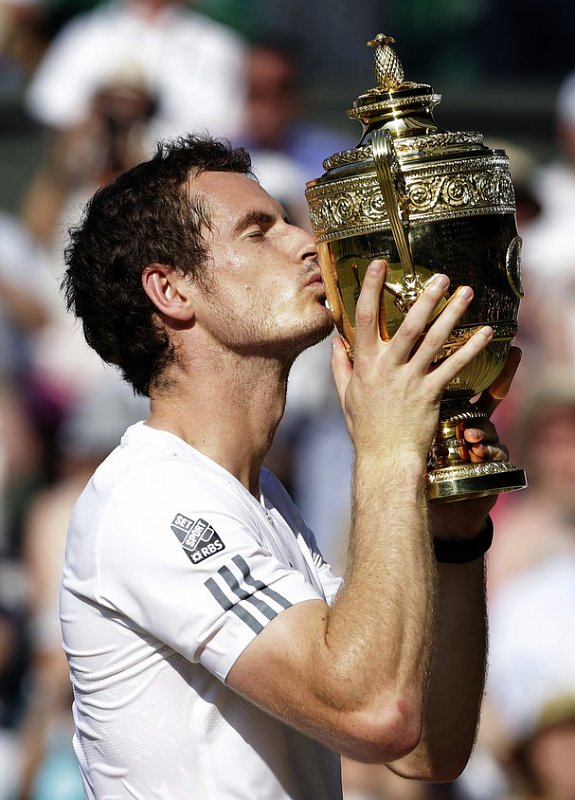
Andy Murray captures his first Wimbledon
title, July 7 2013
The recent successes of Scottish tennis sensation Andy Murray, the reigning Wimbledon and US Open Champion and Olympic Gold Medalist, have highlighted the tragedy he survived as a child.

I join my fellow countrymen in celebrating the first British men’s Wimbledon crown since 1937, the year my father was born.  I also share in the memories and heartache of the school shooting in Dunblane, Scotland where Murray was an eight year-old schoolboy.  With each new Murray victory, the press re-tells the tale of that fateful morning on March 13th 1996 when a gunman, a former scout leader known to the Murray family, entered the Dunblane Primary School armed with four handguns. He shot and killed sixteen children, all aged five or six, and their teacher, before turning a gun on himself and committing suicide.

Andy Murray survived the attack by hiding under a desk in the head teacher’s study. The tennis star has understandably been reluctant to talk about this traumatic event during his professional tennis career. As he has risen up the ATP world rankings to #2, he has opened up more about his experiences, though he says he does not have a clear picture of the events of that day.

Immediately following the Dunblane massacre, American professional tennis player Andrea Jaeger, herself a former world # 2, traveled to Dunblane to lend a hand to the grieving community.  In her words, she “didn’t know how I could help”. She just wanted to help.

Andrea Jaeger in Dunblane, Scotland, May 1996.
Andy Murray is second from the right.
Jaeger’s startlingly successful tennis career as a teenager was cut short by injury when she was 22.  She has since devoted her life to helping children, in particular cancer patients, through her personal work and her Little Star Foundation.  She arrived in Dunblane in 1996 with tennis rackets, nets, balls,
educational and therapeutic toys and games, and an open heart, and tried to help the children of Andy Murray’s school begin to heal. 

Jaeger’s visit was not the beginning of Murray’s tennis career – he was already showing promise at age eight – but the budding young star was certainly inspired by the visit and coaching from the international tennis superstar Jaeger.  In a recent post on her blog, Jaeger shared for the first time a letter that she received in 2004 from Murray’s mother when young Andy, at that point 16, and his older brother Jamie, were still making their way up the World Junior rankings.

Judy Murray wrote:

“Hi Andrea, 

I hope you remember your visit to Dunblane in May 1996. I found your faxes when I was clearing out my garage yesterday and thought you may be interested to know that 2 of the boys you played tennis
Andrea Jaeger, teenage
tennis phenomenon, at age 15 
with at Dunblane Sports Club are now ranked 6 and 70 in the ITF World Junior rankings.”

Mrs. Murray describes her sons’ tournament victories, singles and doubles titles, and world rankings in both men’s and juniors’ categories. You can read the full letter here.  She continues:

“I’m sure your visit inspired both of them to greater things! They realise there is still a long long way to go but both are determined to get as far as they possibly can in tennis.

I hope you are well and that your charity continues to inspire children. Dunblane has made a remarkable recovery after the tragedy but we will never forget.

Yours, Judy Murray,”

Fast forward several years to 2012 and the equally tragic school massacre at Sandy Hook Elementary School in Newtown, Connecticut.  On December 14, a lone gunman entered the school building and shot to death 26 people, including 20 children – all first graders aged six or seven – before killing himself.

At the time, Andrea Jaeger was in Staten Island, NY, helping the recovery relief from Hurricane Sandy when she heard of the shooting.  The next day, she traveled to Newtown to lay flowers outside Sandy Hook Elementary and to offer any support that she could.

Standing outside the makeshift memorial in Newtown, Jaeger said, “I want the children I meet, no matter what has happened to them, to know that they don’t have to fear the world, or every new person they meet.”

She knows that the tennis rackets she brought to Dunblane for Andy Murray and his schoolmates did
Jaeger in Newtown, Connecticut on December 15, 2012
nothing to make them forget the horror of the day at their school and the damage done to their childhoods. She knows that laying flowers outside a Connecticut elementary school will not bring back those who lost their lives.

“They can’t believe that things will ever get better,” Jaeger said in Newtown. “You have to make children, even children who have gone through something as horrible as this, believe that things will get better. It starts with giving them love.”

Despite the eerie similarities between the two school shootings on each side of the Atlantic, there is one glaring difference.

In late 1997, just a year and a half after the Dunblane massacre, the British government acted swiftly to ban private ownership of handguns in mainland Britain, outside of licensed shooting clubs.  The parliamentary vote was taken following a highly successful public campaign against gun ownership that culminated in a petition being handed to the government with almost 750,000 signatures. The new laws gave Britain some of the toughest anti-gun legislation in the world.

All small-bore pistols were included in the ban, along with rifles used by target shooters. Penalties for anyone found in possession of illegal firearms range from heavy fines to prison terms of up to 10 years. There were also firearm amnesties across Britain, resulting in the surrender of thousands of firearms and rounds of ammunition.

The massacre at Dunblane “was one of the most shocking things that has ever happened in this country and it united the country in a feeling that we had to do something," Gill Andrews of the British Gun Control Network said, following the instigation of the new laws. "And I don't think that it would have been possible to make the kind of progress that we have made without that tragedy."

According to official British crime figures, the number of crimes involving handguns committed in the country is in free fall. Between the years 2003 and 2011, handgun crimes fell 44%, from 5,549 annually across the country to 3,105.

In the seventeen years since Dunblane, there have been precisely zero school shootings on British soil.

By contrast, in the United States, where the pro-gun lobby has significant influence over national and local lawmakers – despite overwhelming public opinion in favor of tighter gun control – school shootings continue to make tragic yet regular headlines.

According to statistics from the organization StopTheShootings.org, there have been 387 school shootings in 42 different states since 1992, claiming 510 lives. While Virginia Tech (33 lives lost in 2007), Sandy Hook Elementary (28 lives lost in 2012), and Columbine High School (15 lives lost in 1999) grab a majority of the headlines, there continue to be several school shootings each year all across the nation.

One child’s death is one too many.

Children ages 5-14 in America are thirteen times more likely to be murdered with guns as children in other industrialized countries according to David Hemenway, professor of Health Policy at Harvard University.

The US has the highest gun ownership rate in the world - there are 89 guns for every 100 Americans, compared to 6 in the United Kingdom.
Murder figures in the US are unfathomable for a British public who are accustomed to approximately 550 murders per year. In 2011, the latest year for which statistics are available from the federal Bureau of Justice, there were 12,664 murders in the US. Of those 11,101 were caused by firearms.

The good news for Americans is that firearm-related homicides dropped from 18,253 in 1993 (a reduction of 39%) and non-fatal firearm crimes dropped from 1.5 million victimizations in 1993 to 467,300 in 2011. We are moving in the right direction.

Yet the right direction is only relative:

• no school shootings in Britain since 1997; more than three hundred in the US. 

• 550 murders in Britain in 2011; over 12,500 in the US.

• 3,105 handgun crimes in Britain in 2011; more than 150 times that amount in the US. (side note: the population of Britain is just under a fifth of that of the United States, 63 million vs. 311 million)

American politicians are beginning to make small in-roads towards controlling which types of guns are available to citizens. In Colorado, the state where I live, new laws went into effect just this month requiring universal background checks for all private gun sales and a ban on ammunition magazines that hold more than 15 rounds.

Small potatoes, but a step in the right direction.

I am under no illusion that anyone who may be so determined can get their hands on weapons that were designed for the battlefield.  I am under no illusion that anyone who may be so determined can force their way into any school, movie theater, or other public place where the innocent gather, and do untold damage.

As an educational leader, I have taken steps at my school to mitigate the risk without giving the place the feel of a fortress. A step in the right direction, I suppose.

As I continue to think about the families of Newtown who lost precious children, I am comforted by
Judy Murray is embraced by her son Andy immediately
following his Wimbledon victory, July 7 2013
Judy Murray’s words: “
Dunblane has made a remarkable recovery after the tragedy but we will never forget.” I hope and pray that the Newtown families, and families across the country who have lost children to gun violence, will make a similar recovery.

The chances of a surviving student from Sandy Hook Elementary becoming an Olympic or Wimbledon champion are slim – though not outside the world of possibility. I pray that the chances of us learning from this tragedy and taking steps to ensure another one does not happen are not outside the world of possibility.

In the words of Andrea Jaeger, “You have to…believe that things will get better. It starts with giving them love.”

Thank you, Andrea, for inspiring thousands of children and their families through your Little Star Foundation and all the work you do for kids.  Thank you, Andy, for inspiring a nation and for battling back from such tragedy.

We’re making small steps in the right direction. As Andrea said, “Things will get better.” As Judy Murray added, “There is still a long long way to go.”

Saturday, December 29, 2012

The End of the World, Argo, and Those Two Old F**ks from The Muppets


Turns out the Mayans were wrong.  Maybe they did just run out of space on their stone calendar, or maybe we were just reading it upside down, as various cartoons circulating on the internet suggest. The world is still here. 2012 is wrapping up and 2013 is right around the corner.

Last night Steph and I went to see Ben Affleck’s movie Argo.  It’s a great film.  I’m not usually partial to espionage thrillers, preferring happy escapism to edge-of-my-seat drama, but this was one that I enjoyed. The witty one-liners offered up by the Hollywood characters played by Alan Arkin and John Goodman help break up the tension.  My favorite line was delivered by the CIA higher-up portrayed by Bryan Cranston.  When Affleck’s character is about to enter a meeting with Secretary of State Cyrus Vance and an adviser, Cranston warns that it’ll be “like talking to those two old fucks from The Muppets.”  Which of course reminds me of another internet meme doing the rounds on the subject of the Mayan prediction of the end of the world.  Booo!

Yet, what kind of world have we created at the end of 2012?  It has not been easy by any stretch. I know far too many people who have lost loved ones this year.  Many unexpectedly or too early.  Too many others who have been diagnosed with scary illnesses.

There have been too many headline-grabbing violent crimes, too close to home.  Sandy Hook Elementary, Newtown and Batman: The Dark Knight Rises, Aurora are names that will live in infamy following 2012.  Devastating natural disasters, made undeniably worse by man’s ineptitude, left so many destitute; western wildfires, particularly the Waldo Canyon and High Park fires here in Colorado and Hurricane Sandy on the east coast; overseas, horrific violence claimed the lives of too many innocents in Egypt, Libya, Syria and across the globe. 

In Washington, ridiculous politics and ridiculous money fueled an election that everyone was glad to put behind us. And yet, really, what has changed as obstinate party leaders on both sides refuse to come to an agreement and are about to launch the country off the so-called fiscal cliff and back into recession, preferring to stick to their own hard-headed principles than do what’s best for the rest of us?

Has 2012 truly been any worse than any other year? 

In some ways, yes.  In some ways, no. 

If the 26 victims, 20 of them young children, who were murdered in Newtown, Connecticut just two weeks ago lead this country to tackle the massive problems caused by negligent gun laws and disregard for the mentally ill, that will be a step forward.  If a newly re-elected and invigorated president can persuade a congress to do what’s best for the common man, instead of big-money corporations, that will be a step in the right direction.  If the will of the people can overcome the self-centeredness of the NRA or other special interest groups, we will move forward as a nation.

Will the devastating events at the end of 2012 finally cause us to wake up and face the hard questions? Or will things have to still get worse before they get better?

What is our break point?

The true story told in Argo is one of incredible individual risk-taking and massive inter-governmental cooperation.  A CIA agent risks his own life and flies into revolutionary Iran in order to rescue six American diplomats who are stranded in the home of the Canadian Ambassador’s house in Tehran.  It is only through unprecedented collaboration between the White House, the CIA, the U.S. State Department and the government of Canada that he can possibly succeed.  And it is only because of his incredible bravery and putting his own neck on the line that he does succeed.

This is what it will take for us all to succeed in 2013.  Courageous individuals who take a stand and get the full backing of the power of the people.  Leaders who are willing to put their own necks on the line and say enough is enough.  Common people who will make their voices heard in such numbers that we cannot be ignored.  Common sense over self-centeredness. The will of the people over the will of the few.

The Mayans have given us a second chance.  In the words of Five for Fighting’s World:

“What kind of world do you want?
Think anything.
Let's start at the start.
Build a masterpiece.
Be careful what you wish for,
History starts now….”

It is time to set aside happy escapism and to get real.  It’s time to build a masterpiece. Sign me up.

Tuesday, December 4, 2012

The Safeguard of Democracy


Last month, I cast my first ever vote for President of the United States.  In January 2011, after twenty years as a permanent resident, I became a citizen of the U.S.  This was not a decision I took lightly. It was not an easy thing to turn my back on the United Kingdom, where I had grown up, received a college degree, and where my family still lives.

However, influencing my decision more than perhaps any other factor was the importance of my right to vote. As a nineteen year old at the University of York in the U.K., I voted in a general election for the first time.  For a few years after I moved to Colorado, I voted in British elections from afar, but there seemed something disingenuous about having a say in a place where I neither lived nor paid taxes.

Finally, after far too long, and after acing the citizenship test that twenty years of teaching fifth grade American history and geography had so graciously prepared me for (one of the questions they asked me was “Which ocean is off the west coast of the United States?”), I found myself in the suburban offices of the U.S. Citizenship and Immigration Services in Centennial, Colorado.  In a meaningful and surprisingly emotional ceremony, I stood up with seventy five brand new Americans of every stripe, from thirty six different countries, and swore allegiance to this country.  One of the vows I promised to myself was never to miss out on the right and the privilege to vote.

It is perhaps the most important act that we can perform as a citizen.

The role of good citizenship is something I have been proud to teach my students over the years.  In the words of our newly re-elected President in his victory speech in the early hours of the morning following the election, “What makes America exceptional are the bonds that hold together the most diverse nation on earth. The belief that our destiny is shared; that this country only works when we accept certain obligations to one another and to future generations. The freedom which so many Americans have fought for and died for come with responsibilities as well as rights. And among those are love and charity and duty and patriotism.” To that I would add showing up fully, pursuing a quality education, learning to manage conflict, and showing respect to all.
Citizenship Day, January 26 2011
When the elementary students at Friends’  School in Boulder took to their own polls in the school’s library on Election Day, the teachers urged them to show respect for each other and for divergent viewpoints.
In a note I received from one of the parents, “it is imperative that we show our children how many things connect us rather than the things that separate us. To show the children that respect for each other is more important than the issues that we think divide us. In a nutshell, we as a school must seek to be the change we want to see in the world.”
I couldn’t agree more. Those are among my school’s strongest values.  It is part of our mission: “Our students acquire a strong academic foundation while developing creative expression, social responsibility, and respect for diversity and the individual”.  
It’s what I signed up for when I arrived at Friends’ School and when I raised my right hand and took the oath of citizenship as a United States citizen. 
President Franklin Delano Roosevelt once said, “Democracy cannot succeed unless those who express their choice are prepared to choose wisely. The real safeguard of democracy, therefore, is education.”
It’s good to be here. It’s good to be in education.  It’s good to be able to choose wisely.
It’s good to have a voice.

Sunday, August 12, 2012

The Americans Fight Back


A couple of months ago on this site, I posted an Open Letter to All Americans on the Subject of Beer and lovingly signed it from your friends, the British.  While it was completely tongue-in-cheek and chock full of untruths and assumptions, I was pleased that it elicited a few chuckles from my readers on both sides of the pond.

The best reaction of all was from a small group of American beer lovers, most notably my partner Steph and our friend Rita, who decided to fight back.

They organized a beer tasting event at my house.  I was to provide a sampling of the finest British beer (subject to availability on these shores) and friends were invited to bring along their favorite non-British beer, American preferred, but alternative nationalities accepted.

Game on!  On this final weekend of the London Olympics, let the tasting begin.

Representing Her Majesty’s people of the United Kingdom of Great Britain and Northern Ireland, as procured from the import section of the off-licence (as we Brits like to call our liquor stores) near my house, some of my favorites - see picture above.  Mostly ales, some organic, the assembled crowd agreed that these were frightfully jolly good brews, created in the northern climes of England: Sam Smiths, Boddingtons, Tetley’s, and Newcastle Brown.

Representing a few of the smaller breweries of the United States, here we have beers from Deschutes Brewery in Oregon, New Belgium Brewing in Colorado, and Boulevard Brewing in Kansas City, Missouri.  Mighty fine beers all, and evidence of the grand improvements made in American brewing over the last twenty years.  Not a bad one among the bunch.  Well done, Americans!

Rounding up the pack, a few friends brought beers from the Euro Zone (let’s all say Euro Zone while we still can, eh?) from Belgium and from Bavaria in Germany.  All three came from breweries that had their humble origins in the monasteries and abbeys of the dark ages.  Despite the fairly safe assumptions that the goodly monks and friars didn’t wash their hands and had relatively filthy habits, these beers went down smoothly and were enjoyed by all.

And then there was James. 

Somebody had to invite James.  James too, it is told, enjoyed a few laughs at my Open Letter. The great wag that he is, James decided to stop by his local convenience store and contribute the following to the beer tasting event: Miller, Coors, Budweiser.  Please note (as highlighted in my original post) the spelling of Lite and the on-the-can indicator of whether the beer is merely cold or super cold (whatever that is).  Not surprisingly, most of these beers went unopened during the event.

(Note, if anyone wants free “beer” and is willing to cart off these heinous 24 fl. oz. cans that are currently taking up valuable space in my refrigerator, let me know – first come, first served!)

James’ pièce de resistance was a delightful little number, whose very existence I was joyfully oblivious to, until it showed up in James’ shopping bag, accompanied by a gleeful cheesy American grin on his face.  Ladies and gentlemen, I present to you, I kid you not, Bud Light & Clamato.  For those of you as blissfully uninitiated as I was, Clamato is tomato juice mixed with clam broth and unnamed spices.  Not quite believing what I was seeing, I later stopped by the Clamato website, whereupon I was duly informed that….

”using a top-secret process for mollusk reanimation, our engineers add a small amount of clam broth at just the right moment to give Clamato its unique taste.”

This is what happens, people, when an entire nation is left to its own devices without proper grown-up supervision.  A small minority spoils it for everyone.  They mix shellfish with fruit (or is a tomato a vegetable?) If that is not bad enough, they mix that concoction with beer.  And, it must be asked, what the hell is “mollusk reanimation”?

This is a picture of James drinking Bud Light & Clamato.  Natural consequences if ever there were any.  Needless to say, in our informal poll, this vile hybrid came in last place.

The winners were as follows:

Gold Medal:    Boddingtons
Silver Medal:   Sam Smith’s Organic Best Ale
Bronze Medal: Boulevard’s Tank 7 Farmhouse Ale

Proving conclusively that, while American beer should be commended for trying hard and for most improved, the remaining skeletons in the closet cannot be ignored - and British beer still comes out on top.

Author's note: Despite his faults, James is to be commended on two levels: firstly, for putting his mouth where his money is and drinking most of the whole can of Bud Light & Clamato; secondly, for his excellent taste in girlfriend - the lovely Bernadette brought us delicious peaches from her garden which made it all better.

Thursday, August 9, 2012

Believe It Or Not!


One of the great joys of my career in education is having a few weeks off in the summer for vacations and other pursuits.  I love spending some of that time directing high school students in theater productions.  Each summer I find myself back at the theater program I founded ten years ago, working with a talented and motivated group of kids, putting on a play.  We have developed a tradition of creating fictional biographies of each other – cast and crew – for the program.

Our most recent play, this July, was No Crime Like The Present. These are some of my favorite bios – some were written by me, some by the kids.  Great creativity and silliness.

(I’ve removed names to protect the innocent.  You know who you are!)

Steve de Beer was originally born under a dark cloud in the mountains of Afghanistan, but at age 17, he dug a tunnel under the Indian and Pacific oceans to the United States with a plastic spoon. He surfaced at Broadway, breaking through the stage during a performance of Les Miserables, and thus his love of theater was born. He began touring New York City, discovering his love for theatre at every turn. Once atop the Empire State Building an oversized bird snatched him up and dropped him in Denver where he found his passion for fire breathing. 

EB was born in New Orleans, but was separated from her family during a rowdy Mardi Gras parade when a dancer tripped over her. The man who found her, Enrique “Big John” Sanchez, owned a Tex-Mex restaurant and raised her as a worker. He renamed her Emilia Tocino, after his favorite slaughtered pig on a childhood TV show. One day, a casting director came for a breakfast burrito and was astounded by EB’s raw talent for entertainment. He whisked her away to New Zealand, where she played a flatulent princess in a sci-fi film that never showed in theaters and was instantly catapulted to stardom. After years of movie roles and worldwide fame, EB sought normalcy while visiting her aunt in Denver. While she was hiding from paparazzi in Aunt Lucille’s cellar, EB found a flyer for Stanley’s Theater Camp. She bribed Steve to allow her to participate by offering him unlimited access to her professional makeup stylist, as his deepest desire has always been to be a clown.

JB first uncovered his love for the arts as a professional ballet dancer in northern British Columbia. Once he realized he was sick of tights, JB twirled his way all the way to Denver, where he was discovered, years later, living under a rock in Cheesman Park. It was his time coexisting with moss that made JB find his passion for the performing arts again, but this time, wearing tights while acting.  JB is the only male cast member in this show and appreciates all the backstage chatter about whether he should perform the whole show in just his boxers.  When asked about the lack of boys in the cast, JB was heard uttering, in a high-pitched voice, “Uh, OMG, that’s a lie!” and running out of the room.  He would like to point out that his feet are bigger than everyone’s, even Steve’s.

ZN is an Olympic bronze medal winning synchronized swimmer.  She thinks she looks particularly hot in a tight plastic swimcap and noseplugs.  After auditioning for and getting the part of the sealion in Cirque du Soleil’s aquatic extravaganza, “O”, ZN lived the high life in Vegas until she was way into her 30s.  There she developed an unfortunate addiction to playing nickel slot machines and, on her therapist’s insistence, was transferred to Theater Camp in Denver.  Bending to pressure from ZN’s agent, Steve regularly floods the ballroom so she can perform her best roles. ZN has won the acclaim of the critics, starring in several underwater roles at Theater Camp, including Ursula in The Little Mermaid, Bruce in Finding Nemo, and the pregnant reporter in The Life Aquatic with Steve Zissou.

JP was born in Tennessee to a very happily married couple – a rusty trailer and an antique guitar. She spent her youth raising cows, eventually learning to chase them with a bubble machine if they acted up. This fed JP’s naturally bubbly personality, and she soon sang and danced her way across the country as a famous bubbleologist. After years of blowing bubbles, she got tired. She stumbled upon Theater Camp and fell asleep in the costume rack in the library. She was discovered after she screamed because she saw a moth in the clothing.  Steve held her prisoner as a theater slave.  One late afternoon, he heard her muttering to herself, pretending to be the Sorting Hat. Steve was so entranced by her performance that he begged her to join a Theater Camp cast.

CS No one will ever forget CS’s stunning Theater Camp debut as an eight year old when she starred in the role of Neville Longbottom in Harry Potter and the Sorcerer’s Stone.  She has been grateful to Steve for this casting decision ever since. It was nearly as good as the time she was cast as the lady who got locked up in a coffin or the fat guy with the mustache. As Sarah Palin’s 3rd daughter, CS did her first eleven Theater Camp plays in Alaska, right across the street from Russia. She rarely likes to indulge in politics, so she focuses more on her artistic life, most notably knitting. As a notorious communist, she always takes hair ties from the rich and gives them to the poor. She is Robin Hood in her spare time. CS’s most notable achievements are her numerous awards in interpretive dance, spelling, and Brazilian cooking.

OT was born on a miniature giraffe farm in the middle of Kansas. Her first sounds were those of a giraffe, as that was the only life she knew. After departing from her giraffe family, she backpacked across America to Nebraska. There she became a hippie where she learned the art of braiding armpit hair. From there she was adopted to a traveling circus, where she was the lead clown. After touring the world, the circus came to Denver, Colorado, where OT discovered Theater Camp. She left the circus and decided to pursue a life of theatre. OT currently resides in the little bookshelves of the library at Stanley. Look for a book and maybe you’ll see her.

CH never thought she would be in theater production.  She began her career at a pet store in Ogallala, Nebraska, counting dry food pellets for Chihuahuas but was soon fired for getting kibbles confused with bits.  After bussing tables on trains, training tables on planes, and planing tables on buses, CH tried her hand at performing acrobatics for Barnum and Bailey circus, doing rocket science for NASA, and acting as Mitt Romney’s face double.  She drives a different Honda each day of the week.

GH migrated from Bruges to Denver on Dumbo, the flying elephant. His ginger curls and obsession with Disney whisked him away under the sea to Ariel. When she washed up onto the beach, Ariel dumped GH for a brown haired beach boy. While heartbroken, he walked hundreds of miles until he reached the home of Steve de Beer. Steve, feeling sorry for GH, welcomed him into his home and employed him as a technical lackey. GH has been serving Steve as a live-in slave for seven years now and he could not be happier.

AW cannot believe she still has to hang out with her fourth grade teacher, Steve.  It sucks.  While living in Southern California, AW was a bodyguard and stand-in double for Lady Ga-Ga.  However AW became disillusioned with Ga-Ga’s conservative fashion sense and overall lack of creativity and she moved back to Colorado to pursue her dream of raising baby dragons and pitching alternative dance shows weekly to 9News.  After 9News turned her down for the 57th time, AW finally got her big break on Fox News, where she stars as Attila the Hun’s 4th wife in the show Designing Cupcakes with Rush Limbaugh.

WS was once the size of Stan Van the Weatherman’s marble and was plucked from a berry bush and planted in a box where he grew into a small boy.  With careful watering and force feeding of Miracle Grow, he is now a bigger boy.  He has been a translator for both William Penn and William ‘the  Refrigerator’ Perry.  WS’s hobbies include gilded picture framing, scrapbooking in pastel colors, and free running. Run free, WS, run free.

EH enjoys performing magic tricks, riding donkeys, and winning hotdog eating contests. On one of her longer donkey rides, the donkey veered out of control, panicked and sprinted all the way from EH’s home in coastal Uruguay to Denver, Colorado.  It was the fastest ass in South America. She took the donkey to a feed store in search of hay. There a family of dormice took pity on her and offered her a home in exchange for nightly magic shows. Her love of performing was born.  EH loves to manage props for the high school shows because she gets to play with wine bottles, cigars, and cigarettes.

Tuesday, June 12, 2012

An Open Letter to all Americans


An Open Letter to all Americans 
on the Subject of Beer 
from your old friends the British

Dear Americans,

We are here to help.  That yellow bubbly substance that you affectionately call “lite beer” is not beer. Not at all.

Beer, real ale, is crafted using water, malted barley, hops and yeast, creating a brown, delicious bubble-free nectar of the gods.  It should be capped with a white frothy head at least an inch tall.

That stuff that you like to drink too late at night on your holiday weekends in the back of your pick-up trucks upsetting the peace and quiet at the campgrounds of your National Parks (which are very lovely by the way), is nothing more than 7-Up with a wee bit of food coloring thrown in.  It looks like horse urine and doesn’t taste a whole lot better.

Beer is supposed to be stored at room temperature which, where we live, is a tepid 57° on most days.  It is drawn - or draught, hence the name - from a cask by means of a wooden handle.  Please note the spelling of draught, not draft which is what your government employed to make you fight in the Vietnam War against your will.

While we’re on the subject of spelling, please note that the word light is spelled L-I-G-H-T, the same as bright or fright. Lite is not actually a word and should not be allowed.  Look it up.  We invented the language.

After beer is pulled from the cask (that’s a wooden hand-crafted barrel in case you’re not sure), it is to be poured slowly at precisely a 60° angle into a beer mug, one made of pewter or glass, equipped with a handle.  This exact measurement will procure the desired one inch head. Real beer in casks should never be artificially pressurized. Adding a combination of carbon dioxide and nitrogen to pressurize your kegs is neither funny nor clever.

We disapprove that you have now invented labels that change color to tell you that your “beer” is cold.  Apparently it’s becoming too difficult a task for you to pick up the bottle and feel the temperature against your clammy hand.  We have been informed that you can now go to a “liquor store” (whatever that is) and buy “lite beer” bottles in boxes that are already built as coolers.  Is it really that hard to open a box and transfer the bottles yourself into a cooler, one that you can store in your over-sized garage and use again next time?

Please be advised that Her Majesty’s Government has issued a proclamation declaring that “lite beer” is no longer to be referred to as “beer” at all.  Please refrain from all usage of the term immediately.  You may choose an alternate name from among the following:
“lemonade”
“gnat’s piss”
“yellowy water with bubbles in it”
or
“oh my gracious what is this foul-tasting sack?”

Thank you for your understanding and cooperation.
love,
The British

Friday, June 1, 2012

Gratitude from the Third Grade


Last day of school today.  The third graders at Friends’ School sent me home with a collection of thank you notes they had written after I helped them with their end-of-year play, Roald Dahl’s James and the Giant Peach.

As a head of school, I don’t have as much contact with students as I once did during my twenty years in the classroom, so I cherished my time in rehearsals with the third grade.  They did an outstanding job and the play turned out wonderfully.  The thank you notes contained some great lines:

“Thank you for helping me with the play.  I learned a lot about being loud!”

“Steve, you really can direct.  You showed me how to change in my costume really fast.”

“Thank you so much for hepping me with all my lines and were to stand and when to talk. You heped make me a akter.”  (We’re still working on spelling in 3rd grade.)

“Thank you for helping me with my accent.”

“I learned what stage left and stage right is.”

“Dear Steve, Hey Steve, Thank you for making me the best silkworm ever.”

“What I learned is that you don’t want to talk too fast because the audience won’t understand you.”

“Thank you soooo much.  It was my favorite play ever.”

And my two favorites:

“Thank you for being a good person.” (Wow!)

And this one from a girl who was at a different school last year:


“Dear Steve, you rock.  Sorry I just HAD to say that.  Thank you so so much for helping us with the play!  You the best directer and your way nicer than my old princable Mr Neil.  He’s all gloomy but your all nice and chill.”

So now you know - I’m one chill princable.  Happy summer, kids!